It was a sleepy afternoon, and we lay by a quiet lake. A dragonfly zipped past. Ira traced its shadow with her finger.
'Nanna,' she asked, 'when did animals arrive? Were they always crawling and flying and running around like now?'
Virat lay flat on his stomach, staring into the water. 'Yeah. Did they just appear one day like—BOOM! A lion?'
I chuckled. 'Not even close. Let's ask someone who has seen every creature ever born.'
'I remember the first animal,' said Water.
'It didn't roar.
It didn't walk.
It didn't even have a mouth.
But it was alive.
And it moved.'
Both the kids looked at Water in awe.
'About 600 million years ago,' Water began, 'life had already been around for billions of years—but it was quiet.
Tiny single cells, floating alone, dividing, surviving.
Then, something changed. Some cells started living together. Cooperating. Specializing.'
'And that's when animals were born?' Ira asked.
'Not quite,' Water replied. 'That's when complex, multicellular animal life began. And one of those strange, squishy creatures was called Dickinsonia. It had no eyes. No mouth. It just absorbed nutrients through its skin while lying on the ocean floor.'
Virat frowned. 'That sounds kinda gross.'
Water chuckled. 'Maybe. But it was also the beginning. You wouldn't be here without that strange blob.'
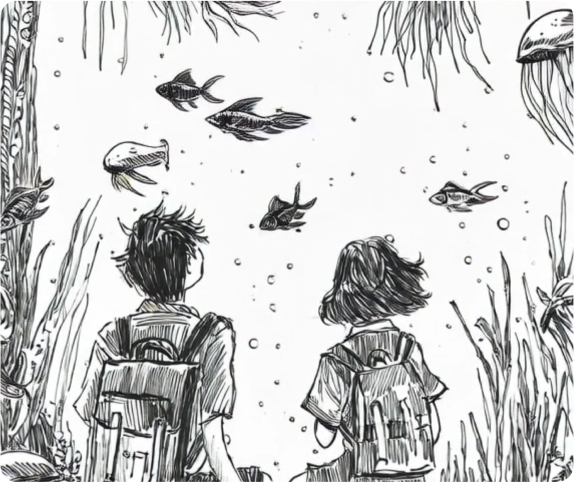
Then came a time we call the Cambrian Explosion,' Water said. 'Around 540 million years ago, life got creative.
Suddenly, animals had eyes, jaws, claws, and armour. They could hunt, hide, and sense the world.'
'Like a wildlife party underwater!' Virat grinned.
'Yes,' Water laughed.
'Creatures like trilobites crawled the seabed with compound eyes. Anomalocaris, a sea monster with rotating jaws, zoomed through the water. And sponges, the simplest animals, just kept filtering.'
Ira looked puzzled. 'Were there no animals on land yet?'
'Not yet,' Water said. 'The sea was where life began, but Earth had much more waiting.'
'Over time, some fish developed jaws to bite, backbones to move better, and gills to breathe underwater,' Water explained. 'Some of them, like Tiktaalik, grew strong fins—so strong they could push themselves through shallow swamps.'
'And then they just got up and walked?' Virat asked.
'Not quite,' Water smiled. 'But some of them evolved lungs too—so they could breathe air. Bit by bit, fins turned into legs, and these early fish became the first amphibians.
They crawled onto land about 360 million years ago.'
'On land,' Water said, 'animals had to change everything - how they breathed, moved, reproduced, and stayed safe.
Over time, they adapted. Some grew thick skins and scales. Others laid strong- shelled eggs. And eventually came the age of the dinosaurs.'
'Wait! Dinosaurs?' Virat sat up.
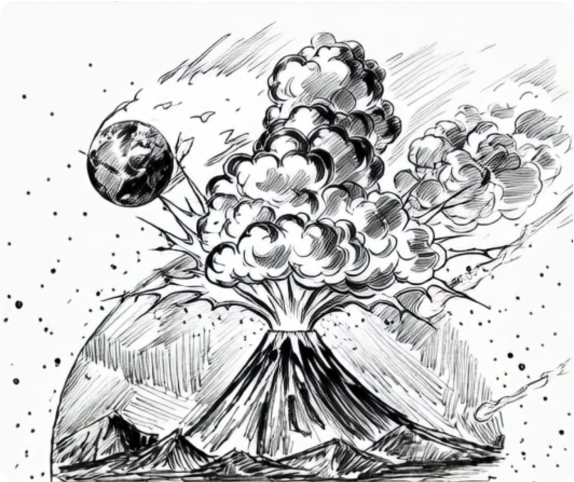
'Yes,' Water nodded. 'They ruled the land for millions of years. But like all stories, theirs came to an end.'
'Then what?' Ira asked.
'When the dinosaurs disappeared,' said Water, 'the stage was open. Mammals—small, furry, clever creatures—got their chance. Some lived in trees, used hands to grab, and slowly got smarter.'
Ira's eyes lit up. 'So . . . that's where we come in?'
'Yes,' said Water. 'You're animals too. Mammals. With hair, warm blood, and live babies. You didn't drop in from space. You grew from this great story.'
Virat's voice was quiet. 'We're part of this long, wild family.'
Water rippled softly. 'Every heartbeat you feel—it's borrowed from creatures that came before you. Every breath, every blink—it carries the memory of fins, feathers, fur.'
We sat in silence, the lake shimmering like it held a billion reflections of the past.
Ira reached down and touched the water. 'So, we didn't conquer nature.'
Virat added, 'We are nature.'
I smiled. 'Exactly. You're not separate from animals. You are one.'
And at that moment, we didn't just hear Earth's story. We remembered it.
You did not arrive after nature. You arrived through it.
Buy Now Read More Stories